
A couple of times a year, I have to tell a client she has to re-brand her business because her business name isn’t safe to use. This usually is because:
- a creative project or hobby turned into a business
- she didn’t realize the need to do a trademark search
- she wanted to capitalize on a trend
If you name your business something too close to someone else’s trademark, you’ll find out sooner or later. (Usually, in the form of a nasty lawyer-drafted cease and desist letter.)
And when it happens, you’ll have to re-brand. You’ll have to start over from scratch. You’ll have to rebuild brand recognition, business goodwill, and pretty much everything.
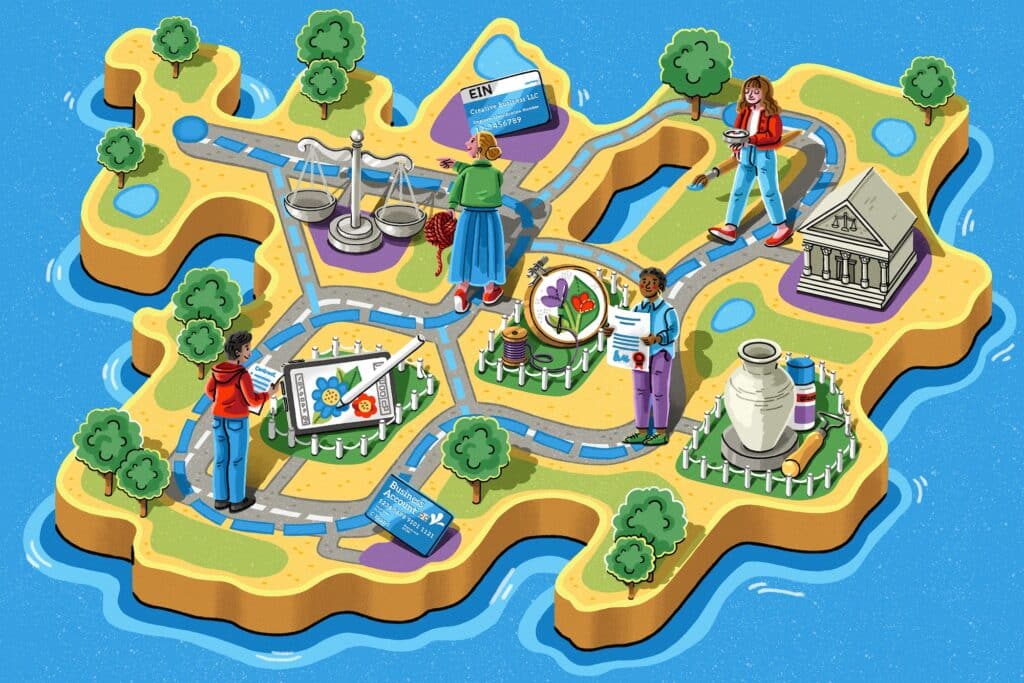
I’ve seen this happen more and more in the last few years, which is why in the Legal Roadmap inside the artist’s Courtyard, it is the first task you complete as part of the Do “enough” legal stuff Map.
You don’t need more information. You need a system.
If you’ve been trying to piece together your legal from blog posts and Google searches, it’s no wonder it feels overwhelming. Inside the artist’s Courtyard, you’ll find a clear, step-by-step system so you can move forward without the chaos.
Of course, not all business names are capable of getting a trademark.
You can’t get a trademark for:
- generic terms (like quilts, jewelry, or photography)
- phrases that merely describe the product or service you are offering (like modern quilts or un-corporate headshots)
And while it can be done, it’s also harder to get a trademark when your name includes:
- your name or the name of a living person
- a geographic location
- a generic or descriptive term even when paired with a non-descriptive term
This week, I’m challenging you to make sure your business name is safe to use. Because even if the URL or social media accounts are available, it doesn’t mean the name is okay.
- If your business name is your name or your business name doesn’t meet the trademark criteria, then, congrats! The challenge is complete.
- If your business name isn’t your name and your business name meets the trademark criteria, then you should do a trademark search ASAP, because that’s how you discover if your name will land you in legal hot water.
A trademark search is doing a little research to find out what other businesses are out there with similar names providing similar products or services.
Sadly, a trademark search isn’t a quick and easy process. In fact, I usually set aside an entire morning to do them. But they are the best way to assure you that you won’t have to change your business name once you finally start landing those big accounts or getting press mentions.
The reason these searches take so long is that you have to search three different places:
- the USPTO database
- a domain name database
- a web search (e.g. search via Google or DuckDuckGo)
And your search has to be for both exact business names and similar business names.
Trademark Search Resources
- This blog post breaks down my step-by-step process for doing a trademark search.
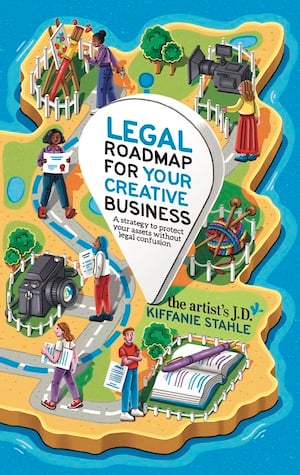
- In the Legal Roadmap, I spend an entire chapter helping you pick a name that won’t land you in legal hot water, including sharing my trademark search process and how to get help doing the search. Buy the Legal Roadmap for $16.99 on Amazon and get a straightforward strategy to get *all* your legal ducks in a row.
- I’m now offering a research service where I do a trademark search for you! You can hire me to do this search for $399. Buy it here.
Protect What You’ve Built. Skip the Legal Busywork.
Here’s the thing: not every legal task deserves your time. This book helps you figure out which ones actually protect your business, so you can stop guessing and get back to work.
Chat soon,

P.S. A Pinterest rabbit hole lead me to these 1940s knitting patterns from the V&A. And the Victoria jumper might just be hitting my needles soon!

If you are scaling a creative business, you already know the legal side matters. The problem is finding the time to handle it properly, so it often gets pushed to the side.
When that happens, small details get missed, and expectations are not as clear as they should be. Clients have questions. Boundaries get tested. And suddenly, you are spending time fixing issues that could have been handled up front.
I am Kiff, a legal strategist for creatives and a licensed attorney with 15+ years of experience helping photographers, designers, and illustrators protect and grow their businesses with clear contracts and client systems.
Each Friday, I send one focused, jargon-free legal task you can complete in 15 to 30 minutes. So you can reduce client friction, protect your work, and keep your business running smoothly without adding more to your plate.
Your privacy is important to us. Learn how we protect it here.